
You never know if or when the shine comes off the star.
But no matter how his U.S. Senate race turns out, James Talarico’s got…it. That’s not a partisan statement; Republicans know it, too. He's an epically strong communicator.
This episode is about what the candidate can teach the Democratic Party as an institution when it comes to the many layers of building and executing a successful communications and policy operation in a red state.
Listen:
Episode notes:
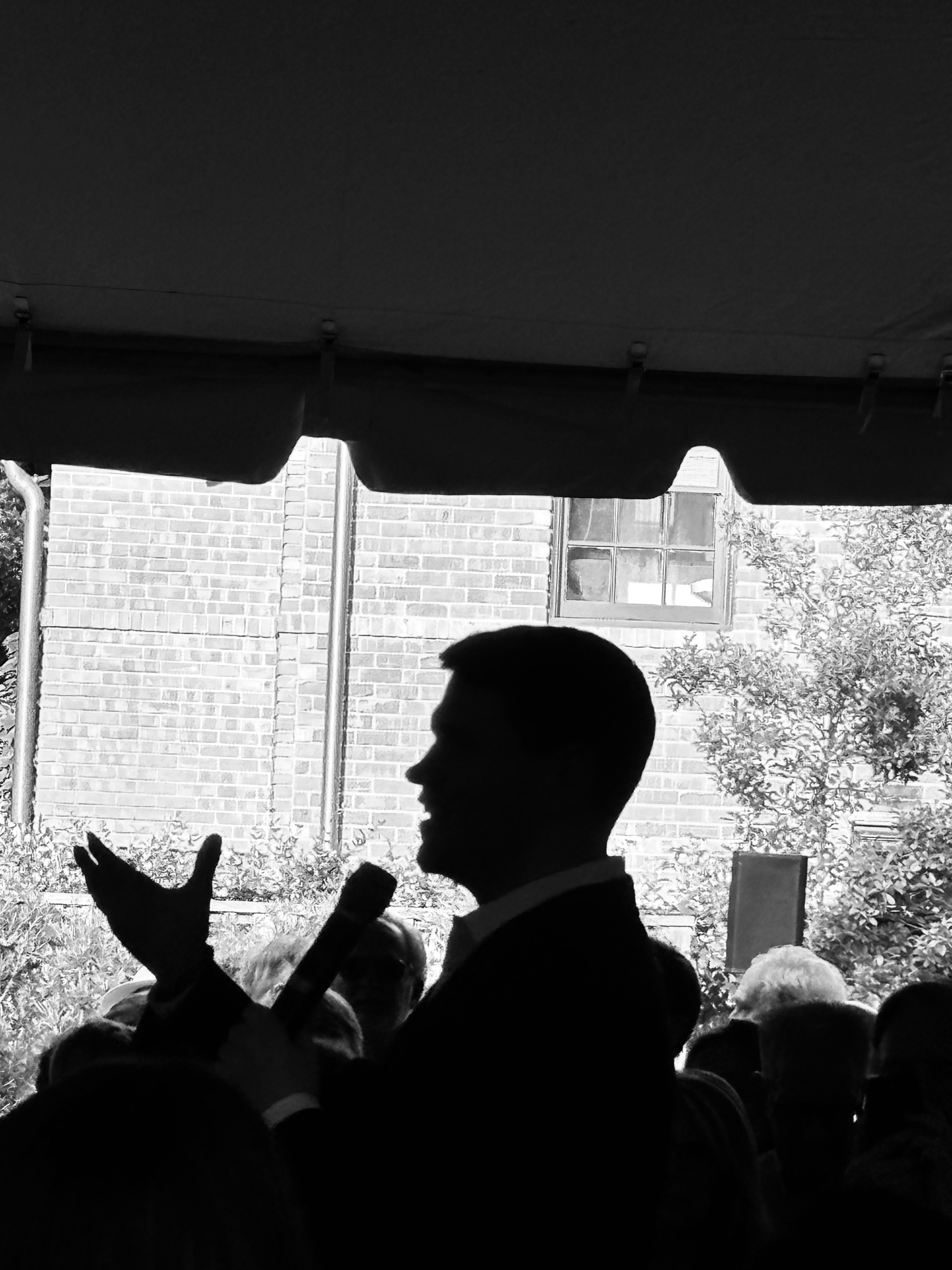
- Photo is taken by me at a Talarico fundraising event in Houston on May 19.
- The narrator is a (good) AI voice by Eleven Labs. AI was only used for the audio.
- Transcript is below, as is the ad referenced in the episode.
Episode 1 transcript:
It's like Walter White in Breaking Bad, or any number of characters in a Shakespearian tragedy. The Democratic Party is moving through life with self-inflicted wounds that don't heal.
There’s a long discussed inability - with notable exceptions—within the party to deliver a message to the American people and have it stick. There's a connection issue. The signal is sometimes barely audible amid the noise.
After its 2014 midterm losses, the Democratic National Committee concluded in its own after-action report, quote, “We lack a clear message about what unites and animates us as Democrats.” It went on to say, “This has contributed to a disjointed style of communicating through long lists of policy statements, which are not well understood or embraced by voters.”
Okay... great...then lesson learned, right?
[annoyed] Nothing changed.
In 2016, Hillary Clinton lost to Trump because, in part, she didn’t have a message. [annoyed] “I don’t think Hillary Clinton wants to do anything in one sentence,” said Barack Obama’s former strategist David Axelrod. “That’s the problem, right? She wants to do things in paragraphs and pages.”
Nothing changed.
In 2024, same story: no message, no brand, and no durable media megaphone to get a message out.
After more than a decade of the same problem, it’s malpractice that donors and party leaders haven’t done a course correction.
Even today, amid loud calls to find that all-important brand, current DNC Chairman Ken Martin has done little on this front. (His recent P.R. disaster was another self-inflicted wound.)
So the smart Democratic candidates have to work extra hard to overcome the party's sour brand. U.S. Senate candidate James Talarico of Texas is one of them. Here’s how he’s doing it.
For any statewide Democrat in Texas to win, this means motivating the base and persuading the persuadables. That’s the only way the math works out.
Talarico's umbrella narrative is tight. It speaks to a large majority of Texans.
He says on a regular basis, quote, "The biggest divide in this country is not left vs. right. It’s top vs. bottom."
A lot is packed in here, but the economy takes center stage. Reducing the explosive cost of living has broad bipartisan appeal. He repeats it often and everywhere, with the right amount of Texas vibe. (You may roll your eyes at that, but some Texa-cana needs to be in any statewide race.)
There’s also a moral overlay to Talarico’s pitch. As a person of faith, Talarico references the Golden Rule and key Biblical figures. He uses general religious teachings to frame what he’s for when it comes to policy positions on the economy, healthcare, immigration and public safety.
And he’s going aspirational—something we haven’t seen since the Obama era. He‘s running on something bigger than politics. His campaign hits all the right notes in the must-watch ad in the transcript:
[excited] The zingers
Everyone knows by now Talarico excels at verbal jujitsu — the undisputed king of one-liners in politics today.
In response to being labeled a vegan, he said, using a pastor’s calm, “I’m an eighth-generation Texan. I’ve been eating barbecue since before Ken Paxton’s first indictment.“
People ate it up.
He also leans on metaphor, saying, "Our southern border should be like our front porch – there should be a welcome mat and a lock on the door.” America can welcome new immigrants, he said, while keeping the people who do us harm out of the country.
He dabbles in comedy, saying “I can’t tell you the number of people who come up to me and [whispers] whisper, ‘I’m not a Democrat’ like they’re in the witness protection program."
Crisp soundbites like these get attention—built for social and news media coverage. They shape public perception. And fit into our horribly short attention spans.
And finally there's this. What also sets the Talarico project apart is its aggressive effort to go on offense immediately. When I say immediately, I mean right after the AP called the Paxton/Cornyn race on that Tuesday night in May. The team had the “oppo” ready to go and an ad up. The campaign is defining Paxton as corrupt and soft on crime, giving leniency and deals to a man accused of three years of child abuse.
Compare that to Democrats --again, speaking in general terms-- who aren’t known for doing negative campaigning all that well, except for their superPACs. Candidates can be slow and allow the other side to define them and issues they care about.
Notably, Talarico is not-so-subtly running against the unwelcoming parts of the Democratic Party.
Is Team “Tala-freak-o” perfect? No, no campaign, candidate, or human being is. His campaign certainly has its work cut out for it, including continuing to court Black voters and raise hundreds of millions of dollars.
Still, public polls, if they’re right, indicate a toss-up at the moment, which in and of itself is an achievement. The nine months of strong comms and branding work has without question paid off.
Moving forward, though, you’ve got to assume the polls are wonky, or that they won’t hold given natural campaign machinations. It would be smart to add at least 3-5 points in Paxton’s favor. This padding is random and mostly made up. The point is this is still Texas. You need to build in the historic reality Texas is a low-voting state, as well as a red state.
And the Paxton-Trump alliance will, I’m sure, be activated in ways we can’t even imagine (but should).
What I do know is that James Talarico joins a relatively small club of savvy communicators on the left. Some of these happy warriors include Obama, AOC, Elissa Slotkin, Zohran Mamdani, Jon Ossoff, Ruben Gallego, Stacey Abrams, and Pete Buttigieg. Some of the skill may be natural. But much of it is learned.
So yet another Democratic star, this time in Texas, is showing the party at large how to do this. Will they finally listen?